
Benefits of capsule wardrobe building: save time, money and stress
A capsule wardrobe delivers measurable time savings, real money back in your pocket, a clutter-free closet, and a noticeably lower environmental footprint. Whether you’re a busy professional commuting into Sydney or a mum juggling school runs and weekend plans, the benefits of capsule wardrobe building are practical and immediate.
Here’s what you gain straight away:
- Saves money — fewer impulse buys, lower annual spend, and a clear price-per-wear advantage on quality pieces
- Saves time — coordinated pieces mean faster mornings and far fewer “I have nothing to wear” moments
- Reduces clutter — a smaller, intentional wardrobe is easier to manage and maintain
- Encourages conscious consumption — you buy less, choose better, and waste far less
- Simplifies travel — micro-capsule rules like the 3-3-3 and 5-4-3-2-1 make packing almost effortless
- Builds personal style — repeating outfits with confidence is a sign of style clarity, not a lack of imagination
Simple rules of thumb (3-3-3, 5-4-3-2-1, 75/25) and Australian cost examples appear throughout to help you act on this today.
Table of Contents
- The core benefits of capsule wardrobe building, explained
- How much money does a capsule wardrobe actually save you?
- How a capsule wardrobe saves time and reduces decision fatigue
- The sustainability case for building a capsule wardrobe
- Why capsule wardrobes make travel so much easier
- How a capsule sharpens your personal style and confidence
- How to build a capsule wardrobe: a step-by-step starter guide
- Common mistakes when starting a capsule and how to fix them
- Key takeaways
- Why the “perfect capsule” is a myth worth ignoring
- Chic capsule pieces worth adding to your wardrobe
- Useful sources
The core benefits of capsule wardrobe building, explained
Each benefit below is real and measurable. Here’s what they look like in practice.
- Money: Buying fewer, better pieces lowers your total annual spend. Australian case studies show families cutting clothing budgets significantly after switching to a capsule approach. A quality blazer worn many times has a much lower cost per wear compared to a fast-fashion version worn only a few times.
- Time: Coordinated pieces eliminate most daily outfit decisions. When everything in your wardrobe works together, getting dressed takes minutes rather than a frantic fifteen.
- Clutter: A 30-piece capsule takes up much less space than a larger wardrobe. Less visual clutter can reduce background stress.
- Conscious consumption: Buying intentionally means fewer returns, less waste, and more considered choices about where your money goes.
- Travel: A micro-capsule built on the 3-3-3 rule (3 tops, 3 bottoms, 3 shoes) generates 27 outfit combinations from nine pieces. That’s a carry-on trip sorted.
- Style: A curated wardrobe forces you to define what you actually like. The result is a consistent, polished look that feels effortless rather than accidental.
Pro Tip: Apply the 75/25 rule: keep most of your capsule as versatile core pieces (neutrals, classic cuts) and reserve some for personality pieces that keep things interesting. A capsule built entirely on neutrals can feel flat after some time.
Quick example: A capsule built for an office commute might include three tailored trousers, two blazers, four tops, two dresses, and two pairs of shoes. That’s 13 pieces generating dozens of workday looks. Add a weekend layer of casual basics and you have a work wardrobe capsule that covers Monday to Sunday without overlap.
How much money does a capsule wardrobe actually save you?
The financial case is the most convincing argument for most Australian shoppers, and the numbers are specific.
A functional 30-piece capsule can be built for AU$1,200–$2,500 at mid-range price points, with annual maintenance (replacing worn items, adding one or two seasonal pieces) dropping to AU$200–$400 thereafter. Compare that to the average Australian who spends significantly more each year on clothing, much of it on impulse purchases that rarely get worn.
| Build phase | Cost range | Annual maintenance |
|---|---|---|
| Budget capsule (30 pieces) | AU$1,200–$2,500 | AU$200–$400 |
| Mid-range capsule (30 pieces) | AU$1,200–$2,500 | AU$200–$400 |
The break-even calculation is straightforward. If you currently spend a typical amount per year on clothing and a mid-range capsule costs a few thousand dollars to build, your ongoing maintenance costs mean you recover the build cost over time and save significantly annually thereafter. That figure compounds every year you maintain the capsule rather than returning to impulse buying.
Price-per-wear is the metric that makes this tangible. A $220 quality knit worn 80 times across two winters costs $2.75 per wear. Understanding affordable vs cheap clothing is the key skill here: affordable means cost-effective over time, not just cheap at the register.
Pro Tip: Buy your capsule foundation during major sales, and phase your build across multiple sale windows rather than buying everything at once to reduce upfront cost and allow time to identify genuine gaps.
How a capsule wardrobe saves time and reduces decision fatigue
The Sydney Wardrobe Company puts it plainly: coordinated pieces eliminate most daily outfit choices, and those saved minutes compound into hours across a year. If you reclaim just 10 minutes each morning, that’s over 60 hours per year returned to you.

The psychological mechanism behind this is enclothed cognition, the well-documented link between what you wear and how you think and perform. When your wardrobe is intentional and coherent, getting dressed becomes a confidence-building act rather than a source of low-grade anxiety. Decision fatigue is real: every trivial choice you make early in the day draws from the same cognitive budget you need for bigger decisions later.
Individuals who adopt a capsule wardrobe report reclaiming hours previously lost to daily dressing and experiencing significant relief from wardrobe-related stress.
Pro Tip: Set up three or four outfit templates at the start of each week rather than deciding fresh each morning. A “Monday work look” and a “Friday casual” template mean your only daily decision is which variation to wear, not where to start.
The sustainability case for building a capsule wardrobe
Buying less and wearing more is the single most effective thing you can do for your wardrobe’s environmental footprint. The fashion industry is one of the world’s most resource-intensive sectors, and sustainable fashion researchers consistently point to reduced consumption as the highest-impact individual action.
For Australian shoppers, the practical sustainability moves are:
- Buy secondhand first — op shops, Depop, and Facebook Marketplace are excellent sources for quality basics at low cost and near-zero environmental impact
- Choose Australian-made where possible — shorter supply chains mean lower transport emissions and easier quality verification
- Seasonal swaps, not duplicate wardrobes — Australia’s climate diversity (tropical north, temperate south, four distinct seasons in Melbourne) means a single 30-piece year-round capsule rarely works. Keep a core base of 20–22 pieces and rotate 8–10 seasonal items rather than building a separate summer and winter wardrobe
- Apply the 5 R’s — Refuse, Reduce, Reuse, Repurpose, Recycle. A capsule approach naturally embeds the first three
- Care for what you own — air-dry where possible, steam rather than iron, and schedule a professional clean for structured pieces once or twice a year. Proper care can extend garment life substantially, which directly reduces replacement frequency and spend
| Sustainability action | Practical benefit |
|---|---|
| Buy secondhand | Near-zero production impact; lower cost |
| Seasonal swaps | Avoids duplicate wardrobes; suits Australian climates |
| Air-dry and steam | Extends garment life; lowers energy use |
| Choose quality over quantity | Fewer replacements; less textile waste |
Why capsule wardrobes make travel so much easier
Packing stress is almost entirely a symptom of an uncoordinated wardrobe. When your pieces don’t mix and match, you pack “just in case” outfits that never get worn. A capsule fixes this structurally.
Two rules do the heavy lifting:
- The 3-3-3 rule: 3 tops + 3 bottoms + 3 pairs of shoes = 27 outfit combinations. Add one layering piece and the combinations multiply further. This is the ideal formula for a long weekend or a 3–5 day work trip.
- The 5-4-3-2-1 method: 5 tops + 4 bottoms + 3 shoes + 2 layering pieces + 1 dress or formal item. Travel experts and TikTok stylists alike recommend this for 1–2 week trips, and it fits comfortably in a carry-on when pieces are chosen in a tonal family.
The maths behind combination dressing is multiplicative, not additive. Five tops paired with four bottoms already gives you 20 base combinations before you factor in shoes or layers.
Carry-on capsule checklist for Australian travellers:
- 3–5 tops in a tonal family (white, cream, navy, or terracotta)
- 2–3 bottoms (one tailored, one casual)
- 1 dress that works for dinner or a day out
- 2 shoes (one comfortable walking shoe, one smarter option)
- 1 light jacket or blazer that doubles as a layer on the plane
- 1 scarf or accessory to shift the mood of an outfit
Pro Tip: Before you zip the bag, photograph each outfit combination on your bed. Reference the photos during the trip so you actually wear everything you packed rather than defaulting to the same two looks.
How a capsule sharpens your personal style and confidence
A curated wardrobe does something a full, chaotic closet cannot: it forces you to define what you actually like. When you own 80 pieces, you can avoid the question indefinitely. When you own 30, every item has to earn its place, and the result is a wardrobe that genuinely reflects your taste.
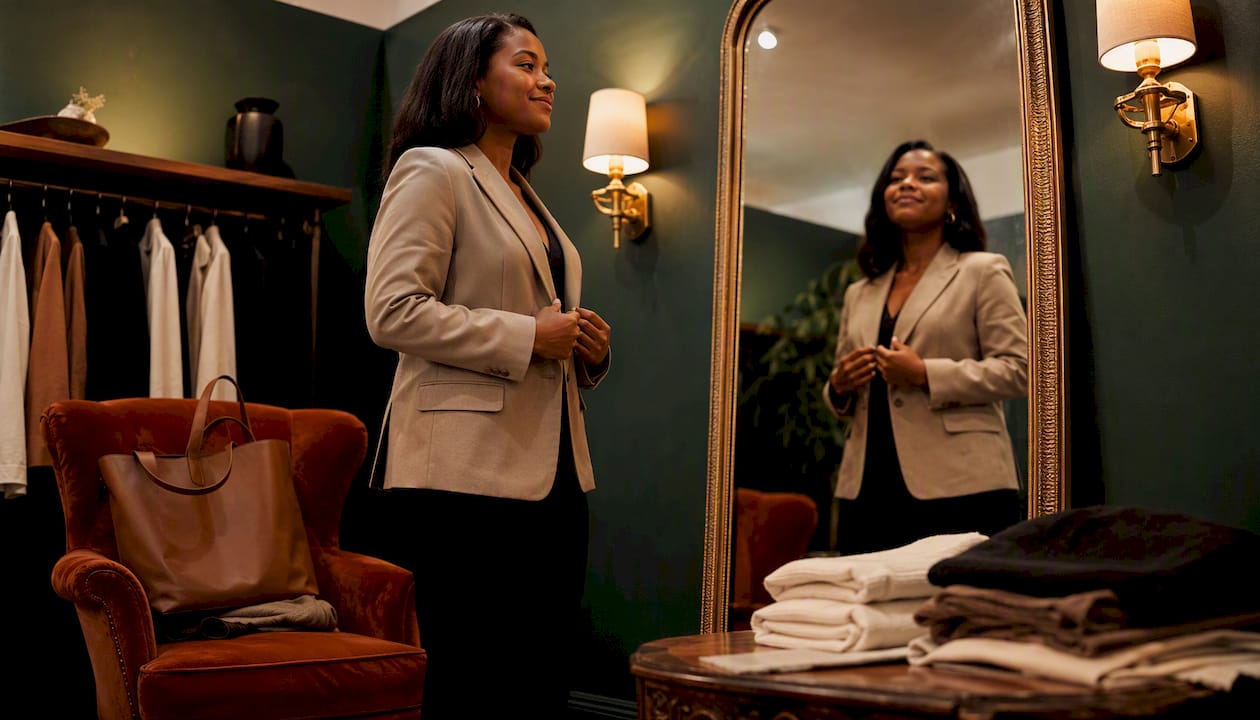
Perceived polish rises when pieces fit well and coordinate intentionally. A well-fitted $90 dress reads as more expensive than an ill-fitting $300 one. Fit is the highest-return investment in any capsule.
To keep a capsule from feeling repetitive, use these levers:
- Texture contrast — pair a smooth silk top with a linen trouser or a chunky knit with a sleek midi skirt
- Accessories as multipliers — a single belt, a statement earring, or a structured bag can shift an outfit from casual to polished without adding a new clothing item
- The 70/30 principle — 70% core neutrals, 30% colour or print. This gives you enough personality to avoid the “uniform” feeling while keeping everything mixable
- Outfit templates — style outfits that move with you across occasions rather than building separate looks for each context
Pro Tip: Invest in one tailoring alteration per season. Hemming a pair of trousers or taking in a blazer costs AU$20–$60 and transforms how a piece looks and feels. It’s the single highest-return spend in a capsule.
How to build a capsule wardrobe: a step-by-step starter guide
You can do this in a weekend. Here’s the sequence:
- Take inventory — pull everything out of your wardrobe and lay it flat. Yes, everything.
- Purge with three piles — Yes (love it, fits, worn in the last 12 months), Maybe (unsure, keep for 30 days in a bag), No (donate, sell, or recycle immediately).
- Define your colour palette — choose 2–3 neutrals (black, white, navy, camel) and 1–2 accent colours that work together. Every new purchase must fit this palette.
- Identify your core silhouettes — the shapes that consistently work on your body and suit your lifestyle. For most women, this is 2–3 trouser cuts, 1–2 dress styles, and a handful of top shapes.
- Shop to fill genuine gaps — list what’s missing, then buy only those items. Apply price-per-wear thinking: spend more on high-frequency pieces (a work trouser worn 3 times a week) and less on occasion pieces.
- Set maintenance habits — review your capsule at the start of each season. Retire worn items, identify gaps, and plan one or two targeted purchases per sale window.
Weekend action checklist:
- Saturday morning: full inventory and purge (2–3 hours)
- Saturday afternoon: define palette and photograph your Yes pile
- Sunday: list gaps, research a few specific items, and bookmark major sales for phased buying.
Pro Tip: Start with a 15–18 piece foundation: 5 tops, 3–4 bottoms, 2 dresses, 2 shoes, 1–2 layers. Wear it for 4–6 weeks before adding anything. The gaps that genuinely frustrate you become your next shopping list, which means every purchase is intentional.
Common mistakes when starting a capsule and how to fix them
Most capsule attempts fail in the first month. Here’s why, and what to do instead.
- Over-purging on day one — donating everything that isn’t perfect leaves you with nothing to wear and triggers a panic-buy spiral. Keep your Maybe pile for 30 days before deciding.
- Ignoring Australia’s climate diversity — a Brisbane wardrobe and a Melbourne wardrobe are genuinely different. Build for your actual climate, not an idealised capsule you saw on a UK blog. Seasonal swaps work better than a single year-round list.
- Buying only neutrals — an all-grey, all-beige capsule is easy to coordinate but boring to wear. The 75/25 rule exists for a reason: personality pieces prevent wardrobe fatigue.
- Under-investing in fit — buying a cheaper size-up because the right size isn’t available is a false economy. A piece that doesn’t fit well won’t get worn, regardless of its price.
- Neglecting garment care — the financial case for a capsule depends on pieces lasting 3–5 years, not 18 months. Air-dry knitwear, steam structured pieces, and store garments properly to protect their shape.
Pro Tip: Rotate your capsule deliberately. Move pieces you haven’t worn in two weeks to the front of the rail. If something stays at the back for a full season, it’s a candidate for the next purge, not a permanent resident.
Key takeaways
A capsule wardrobe built on quality, intentional pieces saves Australian women real money, reclaims hours each week, and produces a more confident, consistent personal style than a full, chaotic closet ever will.
| Point | Details |
|---|---|
| Financial savings | A 30-piece mid-range capsule (AU$1,200–$2,500) typically breaks even over time, with annual maintenance of AU$200–$400 thereafter. |
| Time reclaimed | Saving 10 minutes each morning adds up to over 60 hours per year returned to you. |
| Travel made simple | The 3-3-3 rule (3 tops, 3 bottoms, 3 shoes) generates 27 outfit combinations from nine pieces, enough for most short trips. |
| Sustainability upside | Fewer purchases, longer garment life, and seasonal swaps rather than duplicate wardrobes all reduce your fashion footprint. |
| Indy Love as a starting point | Indy Love stocks versatile dresses and knitwear suited to capsule building, with free shipping on orders over AU$150 across Australia. |
Why the “perfect capsule” is a myth worth ignoring
The most common mistake I see is waiting until conditions are perfect before starting. Waiting until you’ve lost weight, moved house, changed jobs, or found the ideal neutral palette means most people never start at all.
A capsule wardrobe is not a fixed destination. It’s a working system that evolves with you. The 3-3-3 rule is a useful experiment, not a life sentence. The 75/25 split is a guideline, not a formula carved in stone. What matters is that you start with what you have, identify what genuinely frustrates you about your current wardrobe, and make one intentional purchase at a time.
There are real trade-offs worth naming. The upfront cost is the biggest psychological barrier, particularly if you’re building from scratch rather than editing an existing wardrobe. Life changes like pregnancy, significant weight fluctuation, or a major career shift can render a capsule temporarily redundant. In those cases, a phased approach (foundation pieces only, supplementary buys deferred) is smarter than a full rebuild.
The environmental argument is also more nuanced than most guides admit. Buying ten “sustainable” pieces you don’t love and don’t wear is worse than buying three fast-fashion items you wear constantly. Wear rate is the metric that matters most, for your wallet and for the planet.
Chic capsule pieces worth adding to your wardrobe
Indy Love stocks a curated range of versatile women’s clothing that slots naturally into a capsule wardrobe without the premium price tag. The Alice Shirt Dress is a strong example: a single piece that works for office days, weekend brunches, and travel, ticking the high-wear-rate box that makes capsule building financially worthwhile. For a personality piece within your 25%, the Passion Dress adds colour and confidence without disrupting your core palette.
Free shipping applies on orders over AU$150, and fast delivery runs across Australia. Browse the full women’s fashion range to find pieces that genuinely earn their place in your wardrobe.
Useful sources
A short list of credible resources for further reading, all Australia-relevant:
- How a capsule wardrobe is saving me a fortune on clothes — Money magazine: Real Australian cost examples, break-even maths, and the 75/25 core-vs-statement split explained.
- Building a capsule wardrobe in Australia: What it costs and where to buy — ShopBack Blog: Build-cost ranges (AU$1,200–$2,500), maintenance estimates, and phased buying advice for Australian shoppers.
- Capsule wardrobe trick cuts Aussie mums’ clothing costs 70% — SavingsRoom: Australian case studies on household savings, recommended piece counts (30–37 pieces), and a weekend action plan.
- How to set up a capsule wardrobe — Sydney Wardrobe Company: Practical Australian guide covering decision fatigue, time savings, and wardrobe setup steps.
- What is the 3-3-3 rule in fashion — Louie Boutique: Clear explainer of the 3-3-3 micro-capsule formula and its 27-combination maths.
- The 3-3-3 rule capsule wardrobe: complete guide — 1abel: Deeper dive into tonal families and multiplicative outfit maths for capsule systems.
- What Is the 5-4-3-2-1 Packing Method? — Good Housekeeping: Travel expert breakdown of the 5-4-3-2-1 method and how it applies to 1–2 week trips.