
Boutique vs marketplace shopping: what you need to know
A boutique is defined as a small, curated retail store that hand-selects its stock to offer exclusive, stylish pieces with a personal touch, while a marketplace is a large platform aggregating many sellers to deliver broad product choice and competitive pricing. Understanding what is boutique versus marketplace explained clearly is the key to shopping smarter, whether you are after a one-of-a-kind dress or a fast, affordable find. Indy Love Boutique, for example, sits firmly in the boutique category, offering carefully chosen women’s fashion for Australian shoppers. Amazon and Etsy represent the marketplace model, connecting millions of buyers with thousands of sellers under one digital roof. Knowing the difference shapes every shopping decision you make.
What is the difference between boutique and marketplace shopping?
The boutique vs marketplace distinction comes down to curation versus volume. A boutique selects every item with intention. A marketplace lists whatever its sellers supply.
Boutiques like Indy Love operate on a curated scarcity model, often stocking one or two units per size to maintain exclusivity. Once a piece sells out, it is gone. That scarcity is a feature, not a flaw. It means what you wear is unlikely to show up on someone else at the same event.

Marketplaces prioritise availability and price competition. Online marketplaces represented 62% of global retail e-commerce sales in 2024, generating approximately $2.4 trillion in revenue. That scale reflects their core promise: whatever you need, whenever you need it, at the lowest available price.
The fee structures tell the story from a seller’s perspective, and that flows directly to your experience as a shopper. Marketplace sellers pay commission fees of 5%–30% per sale, while boutiques typically carry transaction fees of 0%–3%. Boutiques keep more margin, which means they can invest in better packaging, faster local shipping, and genuine customer service rather than racing to the bottom on price.
| Feature | Boutique | Marketplace |
|---|---|---|
| Stock selection | Hand-curated, limited units | Aggregated from many sellers |
| Transaction fees | 0%–3% | 5%–30% commission |
| Customer relationship | Owned by the boutique | Owned by the platform |
| Returns and packaging | Boutique controls quality | Platform policies govern experience |
| Shopping pace | Slow, immersive, personal | Fast, algorithmic, price-driven |
Pro Tip: Before you buy on a marketplace, check whether the seller has their own boutique site. You may find better service, clearer sizing guides, and a more personal experience buying direct.
How does the shopping experience differ?
Boutiques prioritise slow shopping and immersive personalised experiences, while marketplaces use algorithms to push speed and price above everything else. That contrast shapes every moment of your shopping journey.
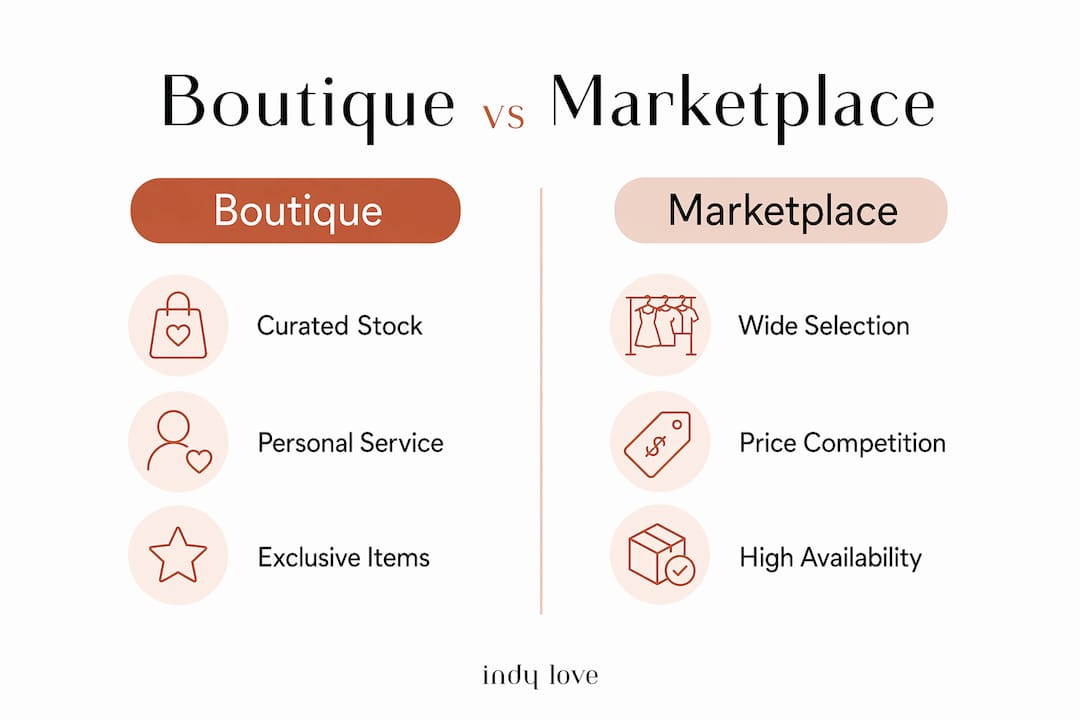
When you browse a boutique like Indy Love, you are engaging with a brand identity. The colour palette, the product descriptions, the styling photos, and even the packaging all tell a consistent story. You are a guest in someone’s carefully designed world. Marketplaces treat shoppers as anonymous users, optimising for clicks and conversions rather than connection or style discovery.
Here is what that looks like in practice:
- Boutique experience: You land on a curated collection page, read a style note about how to wear a piece, find your size in a detailed fit guide, and receive your order in tissue paper with a handwritten note.
- Marketplace experience: You search a keyword, filter by price, compare five listings from different sellers, read generic product descriptions, and receive your order in a plain satchel with a printed invoice.
- Style advice: Boutiques often publish fashion tips and trend guides to help you style your purchase. Marketplaces rarely offer this kind of editorial support.
- Brand connection: Boutiques build loyalty through newsletters, social media, and personal follow-up. Marketplaces own the customer data, so direct brand communication is limited for sellers on those platforms.
Pro Tip: If you want to discover your personal style rather than just buy a product, start with a boutique. The curation does the hard work for you.
What are the pros and cons for consumers?
Both models offer genuine value. The right choice depends on what you are shopping for and what you value most in the experience.
Why boutique shopping wins on style
Boutique owners often hand-select products at fashion weeks or artisan workshops, ensuring unique stock that may never be restocked once sold out. That sourcing process is what makes boutique pieces feel special. You are not buying what an algorithm decided was popular. You are buying what a style expert decided was worth your attention.
Boutique shoppers benefit from curated style advice and brand narratives, which enhances personal expression in a way that anonymous, price-driven marketplace browsing simply cannot match. That personal connection also translates to better after-sales support, easier returns, and a shopping experience that feels genuinely human.
Boutique pros:
- Unique, exclusive pieces with limited stock
- Expert curation that saves you time and guesswork
- Direct customer service with real accountability
- Consistent brand identity and styling support
- Stronger loyalty rewards and personal follow-up
Boutique cons:
- Higher price points than mass-market alternatives
- Limited stock means your size may sell out fast
- Slower brand discovery without existing awareness
Where marketplaces genuinely deliver
Marketplaces excel at convenience, range, and speed. If you need a basic white tee, a pair of everyday sneakers, or a last-minute gift, a marketplace gets you there faster than any boutique can. Marketplaces can yield first sales in as little as one week due to built-in traffic, which reflects how quickly shoppers can find and purchase products on these platforms.
Marketplace pros:
- Enormous product range across every category and price point
- Fast price comparison across multiple sellers
- Quick delivery options, often with same-day or next-day fulfilment
- Buyer protection programmes on major platforms
Marketplace cons:
- Platform policies govern packaging, returns, and communication quality, which can make the experience feel impersonal
- Risk of inconsistent quality across different sellers
- No genuine brand relationship or personalised follow-up
- Counterfeit or misrepresented products remain a real concern
How can you use both models to shop smarter?
The smartest shoppers do not choose one model and ignore the other. Hybrid strategies combining marketplaces for product discovery and boutiques for direct sales are widely recommended, and they benefit consumers just as much as sellers.
Here is a practical framework for combining both approaches:
- Use marketplaces for research. Search for a product category on a marketplace to understand the price range, available styles, and general sizing. This gives you a baseline before you commit.
- Turn to boutiques for statement pieces. When you want something that reflects your personal style, a curated boutique is where you will find it. Pieces from Indy Love, for example, are selected specifically for women who want chic, on-trend fashion without the generic feel of mass-market options.
- Check boutique fit guides carefully. Boutiques invest in detailed sizing information because they care about your satisfaction. Use that information to buy with confidence, especially for dresses and tailored pieces.
- Time your boutique purchases strategically. Boutiques often run limited sales and new arrival drops. Signing up for newsletters from boutiques you love means you get first access to new stock before it sells out.
- Apply boutique quality standards to marketplace purchases. Before buying from a marketplace seller, ask yourself whether the product description, imagery, and sizing information meet the standard you would expect from a boutique. If the listing feels vague or the photos look stock-standard, that is a warning sign.
Smart consumers use marketplaces for price and range, but turn to boutiques when seeking unique, quality fashion with personalised service. That split approach gives you the best of both worlds without overspending or compromising on style.
Pro Tip: Set a monthly style budget and allocate a portion specifically for boutique purchases. Even one or two boutique pieces per season can transform a wardrobe full of marketplace basics into something that feels genuinely personal.
Key takeaways
Boutiques deliver curated exclusivity and personal service, while marketplaces offer scale and convenience, and the smartest shoppers use both with intention.
| Point | Details |
|---|---|
| Boutique definition | A boutique hand-selects limited stock to offer exclusive, stylish pieces with personal service. |
| Marketplace scale | Online marketplaces represented 62% of global e-commerce sales in 2024, prioritising volume over curation. |
| Customer relationship | Boutiques own the customer relationship directly, enabling better loyalty and after-sales support. |
| Fee and margin difference | Boutique transaction fees run 0%–3% versus marketplace commissions of 5%–30%, affecting service quality. |
| Hybrid shopping strategy | Use marketplaces for discovery and price research, then buy statement pieces from trusted boutiques. |
Why boutique culture is making a comeback
I have watched shopping habits shift dramatically over the past decade, and what strikes me most is this: the more overwhelming marketplaces become, the more people crave the opposite experience.
When everything is available all the time, nothing feels special. Marketplace fatigue is real. Shoppers are scrolling through thousands of listings, drowning in choice, and still walking away feeling like they bought something forgettable. That is exactly why boutique culture is resurging, not just in fashion, but across food, homewares, and beauty.
What I find genuinely interesting is the ethical dimension of this shift. Shopping local and supporting boutiques keeps money in communities, supports independent business owners, and encourages more considered consumption. That matters more now than it did five years ago. Consumers, particularly younger Australian women, are asking where their clothes come from and who benefits from their purchase.
My honest observation is that boutique shopping is not just a style choice. It is a values choice. When you buy from a boutique like Indy Love, you are choosing quality over quantity, connection over convenience, and intention over impulse. That is a shift worth making, even if it means buying less and choosing better.
The next five years will see boutiques lean further into personalisation, using technology to offer style recommendations and fit guidance that feel genuinely tailored. Marketplaces will keep growing in volume. But the shoppers who feel most confident and most themselves will be the ones who know when to use each model and why.
— Helen
Discover your style at indy love boutique
If this article has you thinking about the boutique difference, Indy Love is the perfect place to experience it firsthand.
Indy Love is a trusted Australian women’s fashion boutique offering chic, on-trend clothing at prices that do not ask you to choose between style and budget. Every piece in the collection is carefully chosen to suit real occasions, from casual weekend outings to special events. With free shipping on orders over $150 and fast delivery across Australia, shopping boutique has never been this easy. Browse the full women’s fashion collection and discover what it feels like to shop with intention. Whether you are after a stunning silk dress or a chic everyday look, Indy Love has something made for you.
FAQ
What is a boutique in fashion retail?
A boutique is a small retail store that hand-selects a limited, curated range of clothing or accessories, prioritising exclusivity, style, and personalised customer service over broad product volume.
How does a marketplace differ from a boutique?
A marketplace is a platform that aggregates many sellers under one roof, offering wide product choice and competitive pricing, while a boutique is a single curated brand with full control over its selection and customer experience.
Are boutiques more expensive than marketplaces?
Boutiques often carry higher price points than marketplace listings, but the difference reflects better curation, quality control, and customer service rather than simply higher margins.
Can i trust the quality of fashion on marketplaces?
Quality on marketplaces varies widely because many sellers list products without the curation standards a boutique applies. Checking seller reviews, return policies, and detailed product descriptions helps reduce the risk.
Is it worth shopping at a boutique online?
Online boutiques like Indy Love offer the same curated selection, personal service, and exclusive pieces as physical boutiques, with the added convenience of fast Australian shipping and easy browsing from home.