
What does limited stock mean in boutiques?
Limited stock in boutiques means only a small, finite number of units of a specific item or variant are available, often with no restock planned. This is the industry term for what shoppers see labelled as “low stock,” “limited availability,” or “only 2 left.” Understanding boutique limited stock is not just about knowing when to buy fast. It shapes how boutiques like Indy Love build their collections, how shoppers experience exclusivity, and why that “limited stock” banner carries far more meaning than a simple inventory count.
What does limited stock mean in boutiques, exactly?
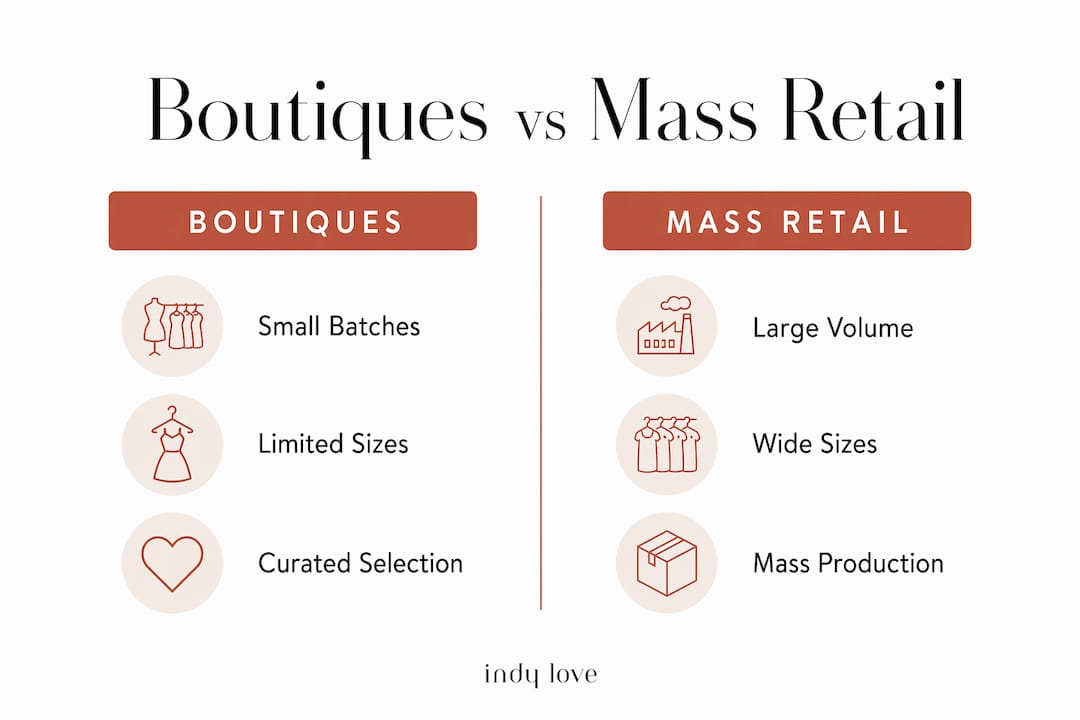
Limited stock is defined as a finite quantity of a product or variant held by a boutique, with no guarantee of replenishment. Unlike mass retailers such as Zara or H&M, which regularly restock popular lines, boutiques operate on curated small batches that sell out and are often gone for good. The term “limited inventory” in this context is not a marketing exaggeration. It reflects the actual production model behind boutique retail.
The scarcity is often variant-specific, not just product-specific. A dress may still appear “in stock” on a product page, but your size or preferred colour may already be sold out. Shoppers who understand this distinction shop more confidently and avoid disappointment at checkout.

How does boutique limited stock differ from mass retail?
The contrast between boutique and mass retail inventory is stark. The table below shows the key differences shoppers need to know.
| Feature | Boutique | Mass retailer |
|---|---|---|
| Stock volume | Small batches, often under 50 units per style | Hundreds to thousands of units per style |
| Restock frequency | Rare or never for the same style | Regular, often within weeks |
| Variant availability | Sizes and colours sell out fast | Most sizes available for longer periods |
| Collection approach | Curated capsule or seasonal drops | Broad, continuously replenished range |
| Scarcity signal | Genuine and structural | Often manufactured for marketing |
Boutiques build their identity around curated selections and smaller production runs. This is not a supply chain limitation. It is a deliberate choice that defines the boutique model. When Indy Love marks an item as limited stock, that label reflects the reality of how the collection was sourced and produced.
Capsule collections are a common format in boutique retail. A capsule is a small, themed group of pieces released together, often with a fixed quantity and no planned restock. Brands from streetwear labels to independent Australian designers use this format to keep their offering fresh and their customers engaged.
Why do boutiques use limited stock messaging?
Limited stock messaging works because scarcity is one of the most reliable psychological triggers in retail. Scarcity drives urgency and pushes shoppers to make faster purchase decisions. The fear of missing out, commonly called FOMO, is a genuine behavioural response, not just a buzzword.
Seeing “only 3 left” does two things at once. It signals that the item is popular (social proof) and that waiting carries real risk. This perception increases the item’s perceived value without changing its price. Luxury brands and streetwear labels like Supreme have built entire business models on this principle.
Limited stock banners also serve as psychological decision cues that accelerate buying beyond pure inventory facts. A shopper who was browsing casually becomes a buyer when scarcity enters the picture. For boutiques, this is not manipulation. It is honest communication about genuine availability.
- Limited stock signals exclusivity, making the item feel special and worth owning.
- Social proof is implied: if stock is low, others have already bought it.
- Urgency reduces the “I’ll come back later” hesitation that kills conversions.
- Perceived investment value rises when an item is known to be finite.
- FOMO is strongest when the shopper already likes the item and sees it disappearing.
Pro Tip: If you see a limited stock label on an item you genuinely love, check the variant level first. Your size may already be gone even if the product page still shows “available.”
What are the practical implications for boutique shoppers?
The most direct implication of limited stock is speed. Items in boutiques, especially popular sizes like AU 8–12, sell out faster than the same styles at a chain retailer. Waiting a day or two to decide often means missing out entirely.
Shoppers benefit from knowing how to read limited stock signals without falling into impulse buying traps. The steps below help you shop boutiques with confidence.
- Check variant availability first. Always select your size and colour before deciding. The product may be in stock, but your specific variant may not be.
- Look for restock information. Some boutiques publish capsule drop schedules or restock dates. If none is listed, treat the item as a one-off.
- Understand the boutique’s restock policy. Capsule releases often have no restock plans at all. If a boutique confirms no restock, that is your signal to decide now.
- Use wishlist or notification features. Many boutique websites let you register for back-in-stock alerts. This removes the pressure to buy immediately while keeping you informed.
- Compare urgency against your genuine need. A limited stock label is real information, not a trick. But it should confirm a decision you were already leaning toward, not create one from scratch.
Pro Tip: When shopping online boutiques, screenshot the item details and your size availability. If you return later and the item is gone, you have a record to help you find a similar style.
Boutiques that publish scheduled capsule drops monthly or quarterly give shoppers a real advantage. You can plan your purchases, set a budget, and avoid the scramble of surprise drops. This is the direction the best boutiques are moving in 2026.
How do boutiques manage limited stock behind the scenes?
Managing limited stock in a boutique is more complex than it looks from the shopper’s side. The table below outlines the key operational practices and their effect on the customer experience.
| Practice | Purpose | Shopper impact |
|---|---|---|
| Basket reservation windows | Holds stock briefly while checkout is completed | Reduces overselling; short windows prevent hoarding |
| Per-customer quantity limits | Prevents bulk buying of limited items | Fairer access for all shoppers |
| Real-time inventory syncing | Keeps website stock counts accurate | Reduces “sold out at checkout” frustration |
| Back-in-stock notifications | Alerts registered shoppers when stock returns | Builds loyalty and reduces disappointment |
| Clear restock communication | Sets expectations upfront | Reduces customer service complaints |
Transparent inventory communication is the single most important factor in maintaining customer trust during limited stock sales. Shoppers who understand the rules feel respected. Shoppers who discover a mismatch between what the website showed and what was actually available feel deceived.
Boutiques also face the challenge of syncing real stock with website displays. When a boutique sells across multiple channels, such as its own website, Instagram, and a physical store, inventory can go out of sync quickly. The best boutiques invest in inventory management tools that update stock counts in real time across every channel. This protects both the shopper experience and the boutique’s reputation.
Ethical stock reservation practices, such as short basket holds and clear per-customer limits, create a fair environment during high-demand drops. Shoppers who miss out feel less frustrated when the process was visibly fair.
Key takeaways
Limited stock in boutiques is a genuine structural reality, not a marketing trick, and shoppers who understand it at the variant level make better, faster, and more confident purchasing decisions.
| Point | Details |
|---|---|
| Limited stock is variant-specific | Check your size and colour availability, not just the product page status. |
| Boutiques rarely restock | Treat limited stock items as one-offs unless a restock date is clearly published. |
| Scarcity drives urgency | Low stock signals both genuine availability and high demand, accelerating purchase decisions. |
| Capsule drops reward planners | Boutiques with scheduled drops let you budget and prepare rather than react impulsively. |
| Transparency builds trust | Boutiques that communicate stock policies clearly retain more loyal, satisfied shoppers. |
My honest view on limited stock as a boutique shopper
The emotional pull of a “limited stock” label is real, and I say that as someone who has been caught out by it more than once. You see three units left on a stunning dress, your pulse quickens, and suddenly a considered purchase becomes a rushed one. That reaction is human. What matters is whether the boutique earned it with honest communication or manufactured it with artificial scarcity.
The boutiques I trust most are the ones that tell you upfront: this is a capsule run, there is no restock, and here is when the next drop lands. That kind of transparency turns scarcity from a pressure tactic into a genuine service. You know what you are dealing with. You can plan. You can decide without panic.
What I have noticed shifting in 2026 is a move away from chaotic hype drops toward predictable microdrops that build loyalty rather than anxiety. The boutiques doing this well are the ones worth following. They treat their shoppers as adults who can handle honest information about stock, and that respect shows in every interaction.
My advice: follow boutiques that publish their drop schedules, read their restock policies before you fall in love with an item, and trust the limited stock label when it comes from a boutique with a track record of honesty. The boutique versus marketplace difference is real, and limited stock is one of the clearest expressions of it.
— Helen
Chic, curated, and always worth it at Indy Love
Indy Love is an Australian online boutique built on exactly the kind of curated, limited stock approach this article describes. Every piece in the collection is hand-selected for style, quality, and wearability, which means quantities are genuinely small and sell-through is fast.
Right now, the Passion Dress and the Moda Maxi Dress are two of the most popular limited stock pieces on the site. The Chantel Shoulder Bag is another must-have that moves quickly. Browse the full Indy Love collection to see what is currently available in your size. Free shipping applies on orders over $150 across Australia, and the team is known for fast dispatch and genuine customer care.
FAQ
What does “limited stock” mean on a boutique website?
Limited stock means only a small number of units of that item or variant are available, often with no restock planned. Boutique e-commerce stores use this label to signal genuine scarcity, not just a marketing prompt.
Will a boutique restock limited stock items?
Most boutiques do not restock limited stock items, particularly those from capsule or small-batch collections. Check the product page or contact the boutique directly to confirm whether a restock is planned.
Why does limited stock create urgency to buy?
Low stock signals both high demand and genuine scarcity, triggering FOMO and social proof responses that accelerate purchase decisions. This is a real psychological effect, not just a retail trick.
Can a product show “in stock” but still be unavailable in my size?
Yes. Variant-level scarcity means specific sizes or colours can sell out while the product page still shows availability. Always select your size and colour before assuming the item is available for you.
How can I avoid missing out on limited stock boutique items?
Register for back-in-stock notifications, follow boutiques that publish scheduled drop dates, and check variant availability as soon as you find an item you want. Predictable capsule schedules from trusted boutiques make planning much easier than reacting to surprise drops.