How to navigate online boutique size guides with confidence
Boutique size guides are the single most reliable tool for buying clothes online without regret. Sizing issues cause 67% of all fashion e-commerce returns. That one statistic tells you everything about why learning to navigate online boutique size guides properly is worth your time. The good news is that reading a size chart accurately is a learnable skill, and once you know what to look for, you will shop with far more confidence and far fewer parcels heading back to the post office.
How do you navigate online boutique size guides correctly?
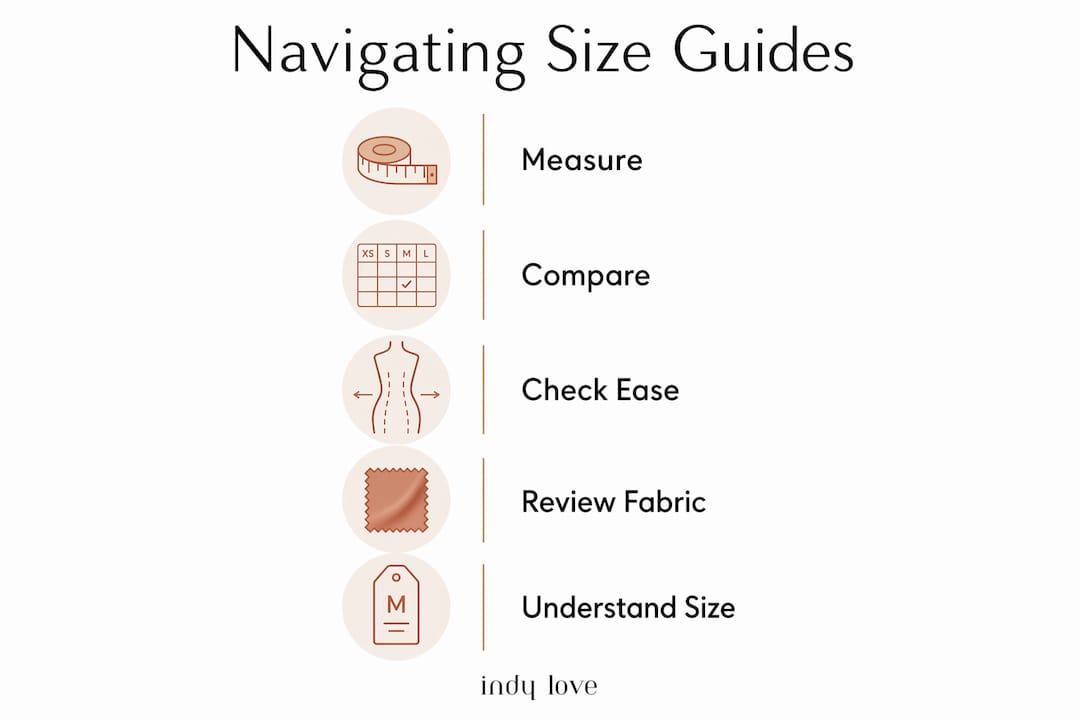
The first thing to understand is the difference between a body measurement and a garment measurement. Your body measurement is the actual dimension of your body at a given point, say your bust or waist. A garment measurement is the dimension of the clothing itself, which is always larger than your body measurement to allow for movement and comfort. That extra room is called ease.
Standard ease runs 3–4 inches for a regular fit garment. Relaxed or oversized styles carry significantly more. Misunderstanding ease is one of the most common reasons shoppers order the wrong size. If a size chart lists garment measurements and you compare them directly to your body measurements expecting a match, you will almost always size up unnecessarily.
The gold standard in boutique size charts is the combination chart, which shows both body measurements and garment measurements side by side. This format removes the guesswork entirely. When you see a chart that only lists S, M, and L with no measurements attached, treat it as a red flag.
Pro Tip: Look for size charts that clearly label whether measurements are “body” or “garment.” If the chart does not specify, contact the boutique before purchasing.
Key things to check on any boutique size chart:
- Whether measurements are body or garment dimensions
- Whether the chart includes ease information or notes on fit style (slim, regular, relaxed)
- Whether the chart covers all relevant body points for that garment type
- Whether the boutique offers a conversion between Australian, UK, US, and EU sizing
UK, EU, and US sizing systems do not directly translate to one another. A size 10 in Australia is not the same as a size 10 in the US. Measurement-based selection is always more reliable than label-based selection.
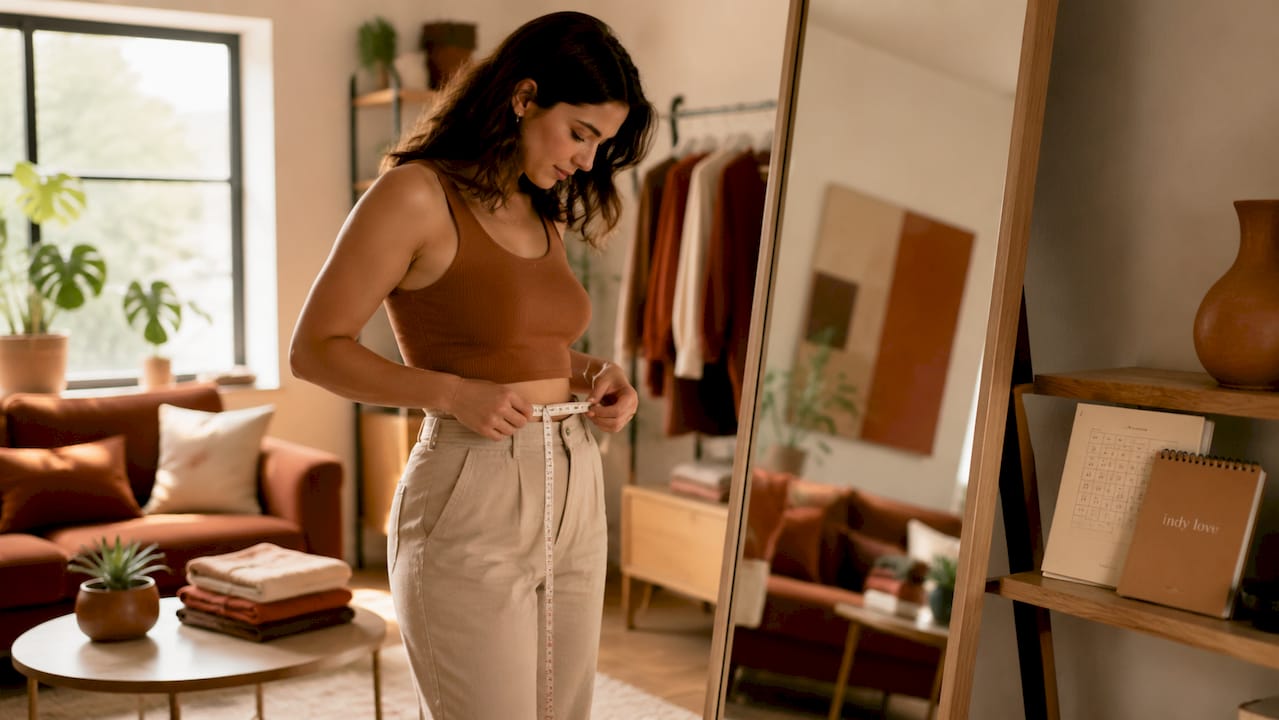
How to take your measurements accurately for boutique shopping
Accurate measurements are the foundation of every good size decision. Taking them correctly takes about five minutes and saves hours of returns and reordering.
Follow these steps for a reliable set of measurements:
- Bust. Wrap a soft measuring tape around the fullest part of your chest, keeping it parallel to the floor. Do not pull it tight. Breathe normally.
- Waist. Measure around your natural waist, which sits above your hip bones and below your ribcage. Stand relaxed, not sucked in.
- Hips. Measure around the fullest part of your hips and seat, usually 20–23 centimetres below your natural waist.
- Shoulders. Measure from the edge of one shoulder to the other across your upper back. This measurement matters most for tops, jackets, and dresses.
- Inseam. Measure from your crotch to the floor along the inside of your leg. This is critical for trousers and jumpsuits.
Stand straight with your weight evenly distributed when measuring. Avoid measuring after a big meal or at the end of a long day when your body may be slightly different. Bodies change over time, so re-measuring every few months keeps your numbers current. A measurement taken two years ago may no longer reflect your actual size.
Pro Tip: Write your measurements in the notes app on your phone or keep a small card in your wallet. Having them on hand when you are browsing boutiques online saves time and prevents guessing.
For more detailed guidance on applying your measurements to specific garment types, the fit guides for dresses from Indy Love walk through exactly how to match your numbers to popular silhouettes.
What do fabric, fit, and style notes tell you about sizing?
A size chart gives you numbers. Fabric and fit notes give you context. Both matter equally when choosing boutique sizes online.
Fabric type directly affects how a garment fits and how forgiving it is. Stretch fabrics like jersey, elastane blends, and ribbed knits have more give, which means a slightly smaller size may still fit comfortably. Woven fabrics like linen, cotton poplin, and chiffon have no stretch at all. With woven fabrics, your measurements need to match the garment dimensions closely, with only the standard ease as buffer.
Reliable boutiques provide detailed fabric composition alongside multiple product photos. When a boutique lists only “polyester” with no further detail and shows a single flat-lay photo, you have very little information to work with. That lack of detail increases your risk of a poor fit significantly.
Style notes also carry sizing implications. A high-rise trouser fits differently at the waist than a mid-rise cut. A puff sleeve dress may require sizing up in the shoulder even if your bust measurement fits the standard size. A bodycon silhouette leaves no room for ease, so your body measurements need to align closely with the garment measurements.
Watch for these red flags when reading boutique product pages:
- Vague fabric descriptions with no composition percentages
- No mention of fit style (slim, regular, oversized)
- Only one or two product photos with no model measurements listed
- Size charts that only show S, M, L without any centimetre or inch values
- No information about garment length or rise
Critical measurement areas differ by garment type. For tops and dresses, prioritise bust and shoulder measurements. For trousers and skirts, prioritise hips and rise. Knowing which measurement to focus on for each garment type cuts your decision time in half.
Where do you find boutique size guides when they are not obvious?
Most boutiques place their size chart in one of three locations: within the product description, in the product image gallery as a dedicated size guide image, or in a separate “Size Guide” link near the add-to-cart button. Check all three before assuming a chart does not exist.
If you genuinely cannot find a size guide, search the image gallery and product description first. Boutiques sometimes embed size information as an image rather than text, which means it will not appear in a page search. Scroll through every product image before concluding the information is missing.
When no size guide exists at all, contact the boutique directly. Ask for the specific garment measurements in centimetres for the size you are considering. A good boutique will respond within 1–3 business days with the information you need. Some will even offer a personalised recommendation based on your measurements.
Practical steps when size guides are missing:
- Use the live chat function if available for a faster response
- Ask specifically for garment measurements, not just size equivalents
- Request the model’s height and the size she is wearing if photos are available
- Check customer reviews for fit comments, as shoppers often mention whether items run large or small
Pro Tip: Never purchase a fitted item without size information or a way to contact customer support. For relaxed or oversized styles, there is more room for error, but for tailored or bodycon pieces, missing size data is a genuine risk.
Understanding how to identify trustworthy boutiques before you shop is also worth your time. The guide on boutique vs marketplace shopping from Indy Love covers what to look for in a reliable online retailer.
What should you do when you are between sizes?
Being between sizes is the most common sizing dilemma in boutique shopping. The right answer depends on the garment type, the fabric, and which body area is most critical for fit.
Trusting size labels alone is unreliable. A size 12 at one boutique may measure identically to a size 14 at another. Always go back to the measurements.
| Factor | Size down | Size up |
|---|---|---|
| Fabric stretch | Stretchy fabric with good give | Woven or rigid fabric with no stretch |
| Critical area | Measurement fits the smaller size | Measurement fits the larger size |
| Garment silhouette | Relaxed, oversized, or boxy style | Fitted, tailored, or bodycon style |
| Garment type | Knitwear, jersey, elastane blends | Linen, cotton, chiffon, structured pieces |
| Customer reviews | Reviews say item runs large | Reviews say item runs small |
When your measurements fall between two sizes, prioritise the critical area for that garment type. For a fitted dress, the bust and shoulders take priority. For trousers, the hips and rise take priority. You can often adjust a waistband with a belt, but you cannot adjust a shoulder seam or a hip that will not zip up.
Customer reviews are an underused resource. Shoppers who have already purchased the item will frequently note whether it runs true to size, large, or small. A pattern of “runs small, size up” comments across multiple reviews is reliable guidance.
Key takeaways
Accurate measurement and a clear understanding of ease are the two factors that most reliably prevent sizing mistakes in boutique online shopping.
| Point | Details |
|---|---|
| Ease changes everything | Standard fit garments include 3–4 inches of ease beyond your body measurements. |
| Combination charts are best | Size charts showing both body and garment measurements side by side reduce guesswork significantly. |
| Re-measure regularly | Body shapes change over time, so update your measurements every few months for accuracy. |
| Prioritise the critical area | Focus on bust and shoulders for tops, hips and rise for bottoms, when choosing between sizes. |
| Missing charts need action | Contact boutique support for garment measurements before purchasing any fitted item without a size guide. |
Why I stopped trusting size labels entirely
I spent years buying clothes based on the size label and wondering why the fit was inconsistent. A size 10 in one boutique sat perfectly. The same label in another was unwearable. The turning point was the moment I started measuring garments I already owned and loved, then comparing those numbers to new size charts rather than comparing my body to a label.
The concept of ease changed how I shop. Once I understood that a garment is supposed to be larger than my body, I stopped panicking when a size chart showed measurements bigger than mine. I started looking for combination charts as a quality signal. Boutiques that invest in clear, detailed size guides are almost always the same boutiques that invest in quality construction and honest product photography.
My honest advice is to be patient with the process. Taking your measurements takes five minutes. Checking a size chart takes two. Contacting a boutique for clarification takes one email. All of that is faster and cheaper than returning a parcel. The shoppers who get sizing right consistently are not lucky. They are methodical.
— Helen
Indy Love makes sizing straightforward for every shopper
Indy Love is an Australian online boutique built around the idea that every woman deserves to feel confident in what she wears, without the stress of guessing her size.
Indy Love’s product pages include clear size guides with body and garment measurements, so you can shop with the kind of certainty that makes online buying genuinely enjoyable. The customer support team is ready to answer specific sizing questions and offer personalised recommendations when you need them. Whether you are eyeing the chic Anna Knit Set, the stunning Melanie Chiffon Midi Dress, or the breezy Aurora Sun Dress, the size information you need is right there on the page. Free shipping on orders over $150 makes it even easier to find your perfect fit at Indy Love.
FAQ
What is ease in a clothing size guide?
Ease is the extra room built into a garment beyond your actual body measurements. Standard ease is 3–4 inches for a regular fit, and more for relaxed or oversized styles.
Why do boutique sizes vary so much between brands?
There is no universal sizing standard across countries or brands. UK, EU, and US sizing systems do not directly translate, so measurement-based selection is always more reliable than relying on a size label.
What should I do if a boutique has no size guide?
Check the image gallery and product description first, as size charts are sometimes embedded as images. If nothing is available, contact the boutique directly and ask for garment measurements. Most boutique support teams respond within 1–3 business days.
Which measurements matter most when choosing boutique clothing?
For tops and dresses, prioritise bust and shoulder measurements. For trousers and skirts, focus on hips and rise. These critical areas are the hardest to adjust and the most likely to cause fit problems.
How often should I re-take my measurements?
Re-measure every few months, as body shapes change over time and measurements taken a year or two ago may no longer be accurate.